
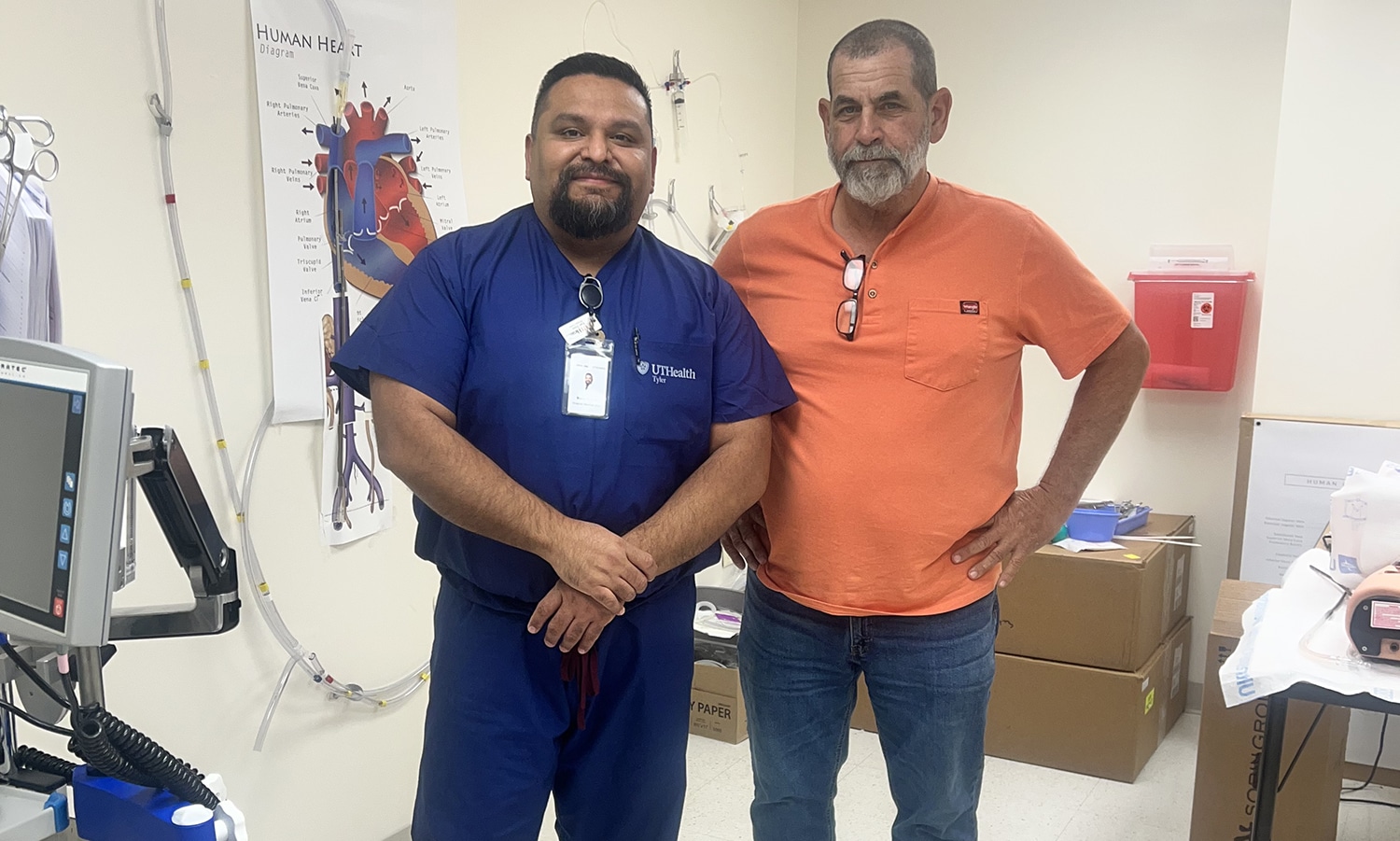
By the time David Fritz arrived that afternoon at UT Health Tyler, his life was in immediate danger.
A massive blood clot had lodged itself at the split in his main pulmonary artery — a condition known as a saddle pulmonary embolism. The clot was blocking blood flow to both lungs, starving his body of oxygen and putting enormous strain on his heart. Without rapid intervention, the risk of cardiac arrest or death was high.
Fritz, a 58‑year‑old truck driver from Emory, Texas, thought the pain he felt was just another aftershock from weeks of medical complications. He had already endured multiple abdominal surgeries after going in for what was supposed to be a routine appendectomy. That procedure spiraled into intestinal damage, blood loss, sepsis, and a stress-induced heart attack, keeping him hospitalized for more than a month.
Further complications
When he finally returned home, he hoped the worst was behind him. But within a week, the pain came roaring back — sharper, deeper and frightening.

“My wife heard me moaning in the bedroom,” Fritz said. “It just kept getting worse.”
An ambulance took him to a nearby Emergency Department, where imaging revealed the massive clot. Doctors quickly realized the gravity of what they were seeing and arranged to have him airlifted to UT Health Tyler, where advanced heart and lung support was available.
When David arrived, the critical care team identified him as a high-risk pulmonary embolism patient. His oxygen levels were unstable, his heart showed signs of strain, and lab values confirmed the seriousness of the situation. The ECMO team was called in immediately.
Heart and lung bypass
ECMO, or extracorporeal membrane oxygenation, is often described as a heart-and-lung bypass. Blood is routed out of the body to a machine that adds oxygen and removes carbon dioxide, then pumps it back in — allowing the heart and lungs to rest and stabilize.
For Fritz, ECMO wasn’t optional. It was the only way to keep his body functioning while surgeons worked to remove the clot that was threatening his life.
“They thought they were dealing with something much smaller at first,” he said. “There was so much going on. I was a pretty good mess by then.”
Once placed on Veno-arterial ECMO, Fritz’s circulation and oxygenation stabilized. With the machine doing the work of his heart and lungs, cardiologists were able to safely perform a mechanical thrombectomy, using specialized equipment to remove the clot from his pulmonary arteries.
“All that clot was basically choking off blood flow,” he said. “Nothing could work right.”
The ECMO support remained in place for several days as his body recovered. In total, he spent about ten days in the hospital during that stay, including three days on ECMO. Gradually, the machine was removed, and his heart and lungs resumed normal function.
Appreciation
Fritz and his wife, Tammi, credit the UT Health Tyler team — especially ECMO Program Director Mario Padilla — for guiding them through the scariest moments.
“He really took the time to explain things,” Tammi said. “He listened, and it helped knowing he’d done this before. We were scared, but he made us feel like David was in good hands.”
Recovery didn’t end when Fritz went home. He was weak, discouraged and unsure how to get back to normal. At first, he barely wanted to move. But Tammi and their granddaughter wouldn’t let him give up.
“She told me we were walking, even if it was just to the mailbox,” Fritz said. “And we did.”
Those short walks turned into longer ones. Light gym workouts followed. Slowly, strength and confidence came back.
Today, Fritz is back at work and grateful to be alive. He knows staying healthy takes effort — and movement.
“I’ve got to keep exercising,” he said. “Whether it’s walking my dog or working out with a trainer, I know now I can’t stop. I want to stay around for my family.”
And thanks to a perfectly timed chain of care — and a machine that took over when his body couldn’t — David Fritz has that chance.
To learn more about ECMO and our interventional cardiology services, visit our website.