
When Mark Raiborn first began feeling sick in April 2023, he brushed it off as a cold. His wife of more than 30 years, Angela, and their three foster children had just recovered from similar symptoms, so he assumed he was simply the last to catch it.
“I woke up the next day and said, ‘I feel like I’m dying.’ I had no energy, and I remember thinking, ‘I never feel like this,’” said Mark, who, along with Angela, owns and operates Birmingham Golf Club in Rusk. When he still wasn’t improving the following day, the couple headed to urgent care in Jacksonville, expecting he’d get a prescription and be sent home to rest.
Instead, Mark watched concern spread across the caregivers’ faces as they took his vital signs. His blood pressure was so alarming that he was told he needed to be transported to the hospital immediately by ambulance.
“I was just hoping I wouldn’t have to stay overnight,” he said. “The Astros game came on at 7:15, and I didn’t want to miss it.”

But that night, Mark’s condition rapidly worsened. By the next morning, he was taken by a second ambulance to UT Health Tyler. His last memory before losing consciousness was hearing the paramedics reassure him: “It’s OK — we’ll be there in 12 minutes.”
The next thing he remembers is waking up a week later, unaware that he had been in the ICU on a ventilator. His medical team had discovered the cause of his illness: Group A Streptococcus — a common bacterium that is usually mild but, in rare cases, becomes invasive and life-threatening. For Mark, the infection triggered sepsis, a critical emergency in which the body’s overwhelming response to infection causes widespread inflammation, organ damage and, if untreated, death.
“At this point, I was just blown away. Things kept going from bad to worse,” Angela said. “At one point they told us to have the kids come and start saying our goodbyes.”
Although Mark eventually stabilized and was weaned off the ventilator, sepsis had already taken a devastating toll on his body. The extreme inflammatory response cut off blood flow to his extremities, causing irreversible tissue damage. Mark would need amputations — several fingers and both legs below the knee.
“At first I thought, ‘I’m not going to be able to do anything. I’m going to be a burden on my family.’ I wanted to die,” Mark said. “For two or three days, I just didn’t want to live. But then, what I can only describe as the hand of God brought this calmness over me. I felt it go right through me. I thought, ‘OK, let’s do this. Let’s get this surgery done now.’”
After 85 days combined at UT Health Tyler and UT Health East Texas Rehabilitation Center, Mark finally left the hospital for good — standing on his new prosthetic legs.
“It takes a lot of willpower,” he said of his recovery. “I made up my mind. I thought, ‘Why can’t I do all those things?’ I flipped the list of things I couldn’t do into a list of things I refused to give up.”
Mark said the care team at UT Health East Texas also helped inspire him. “The nurses would say, ‘We can tell you’re going to be fine, we can tell you’re going to make it,” he said.
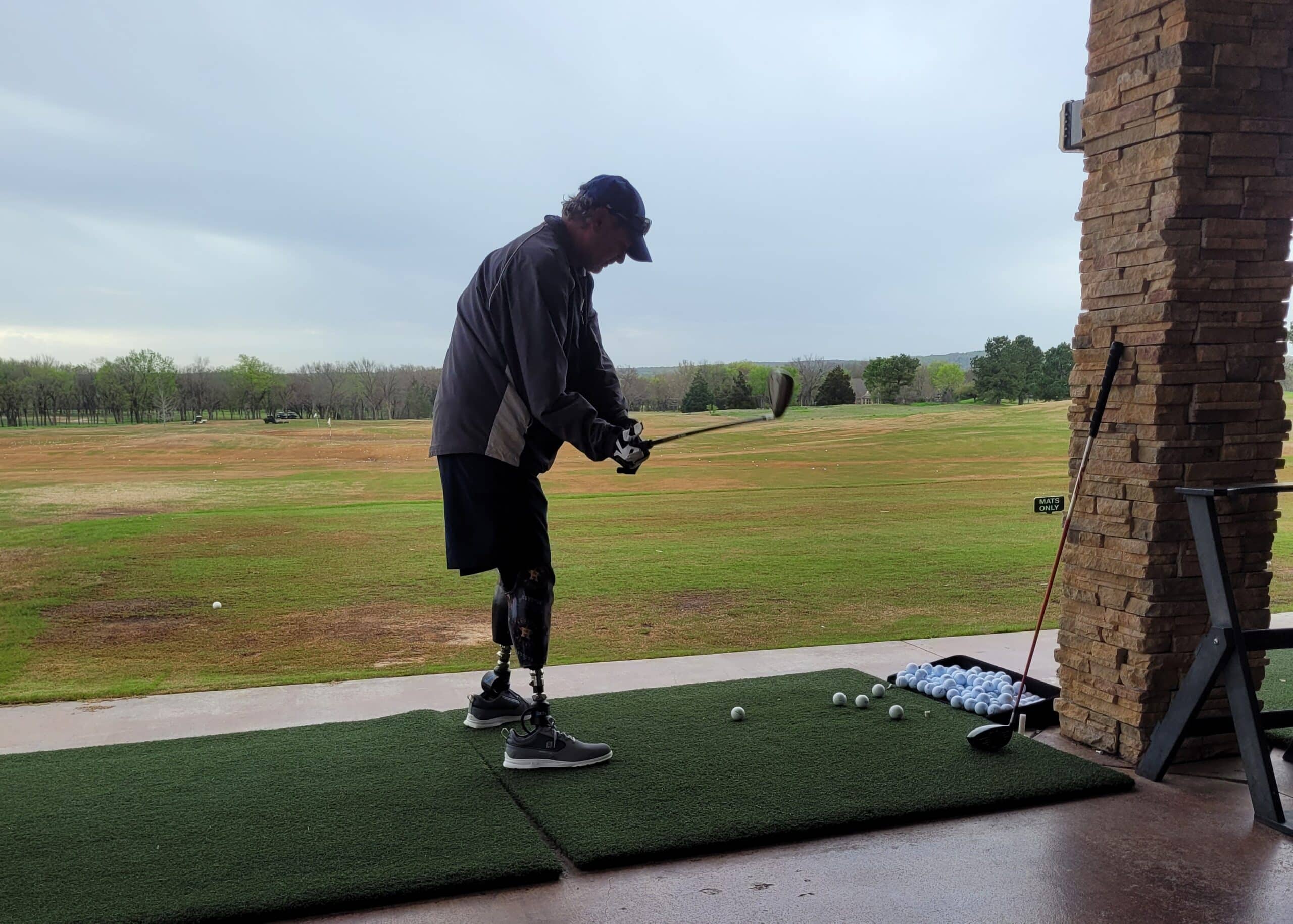
His determination has paid off. Mark is back tending his nine‑hole golf course — now with help from his grown children — and he’s golfing again himself. He plays in amateur adaptive golf tournaments and recently shot a 77.

Angela believes he is happier now than ever, and together they share his story with churches across the region.
“You have to look for joy in every circumstance,” she said. “And it’s there — you just have to find it.”