
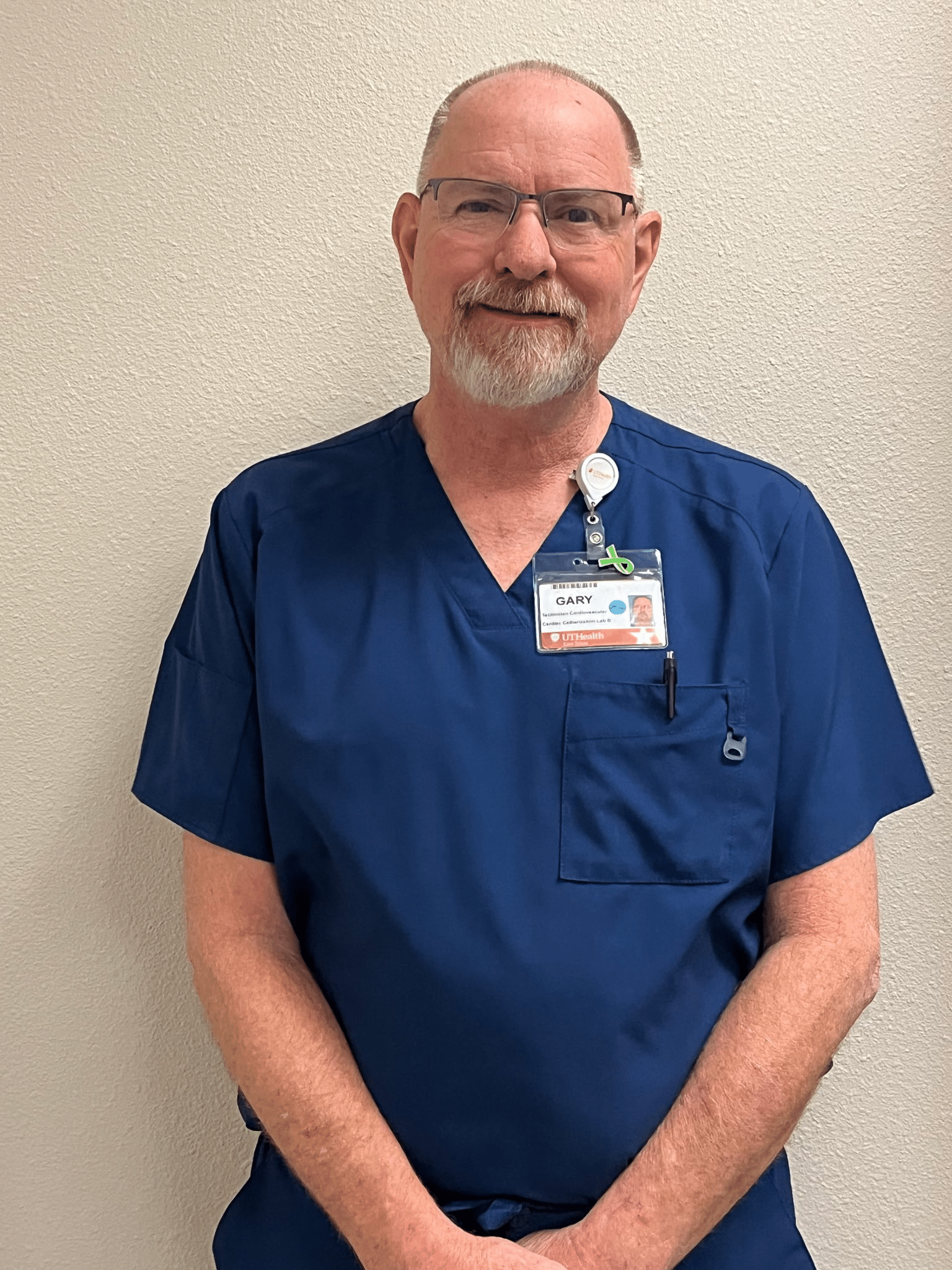
At 64, Gary Smith has spent most of his career in the cath lab, working side by side with cardiologist Frank Navetta, MD, FACC, FSCAI at UT Health East Texas in Tyler. What he didn’t expect was that one day he’d become the patient—and that the condition he’d been quietly battling for years would nearly knock him off his feet.
Gary had long dealt with high blood pressure, but he rarely checked it. “I’ve been on meds for years, felt better, and figured I was fine,” he said. But the signs were there. His hands were constantly hot—hot enough that coworkers jokingly called him “skillet hands.” He brushed it off.

Then one day at work, while holding pressure on a patient’s femoral artery, he suddenly felt lightheaded. “I told the patient’s family, ‘If I go down, go get help, because we’ll both need it,’” he said. When a nurse checked his blood pressure, it was 242/140.
Even after restarting medications and trying different combinations, nothing brought it down. Gary was dealing with resistant hypertension, a form of high blood pressure that doesn’t respond well to standard treatment.
New procedure
Dr. Navetta had been following Gary’s numbers closely. After returning from training on a new procedure—renal denervation—he told Gary he believed it could help. The minimally invasive treatment uses radiofrequency energy to disrupt overactive nerves around the renal arteries, which play a major role in blood pressure regulation.
Gary helped Dr. Navetta in the first case the team performed. Then, he became the second patient.
“It’s not surgery, and it’s not painless,” he said. A catheter is threaded through the femoral artery into the kidneys, where the nerves are treated in stages. “It burns, but I’ve got a high pain tolerance,” he said. “And it worked.”
Without changing his medications, Gary’s blood pressure began to fall. Eventually, he was able to stop one of his diuretics. Today, his readings hover around 150/74—far from perfect, but dramatically better than before.
More importantly, he has his energy back. After work, instead of collapsing into a chair, he’s outside tending to his 15 acres, caring for his horses, cooking for friends, or firing up one of his three smokers. “I’m moving again. I’m doing things,” he said.
Gary credits Dr. Navetta’s enthusiasm and transparency for giving him confidence. “He came back from that training like a kid in a candy store,” Gary said. “He told me everything, and he was excited because he knew it could help.”
And for Gary, it did.